

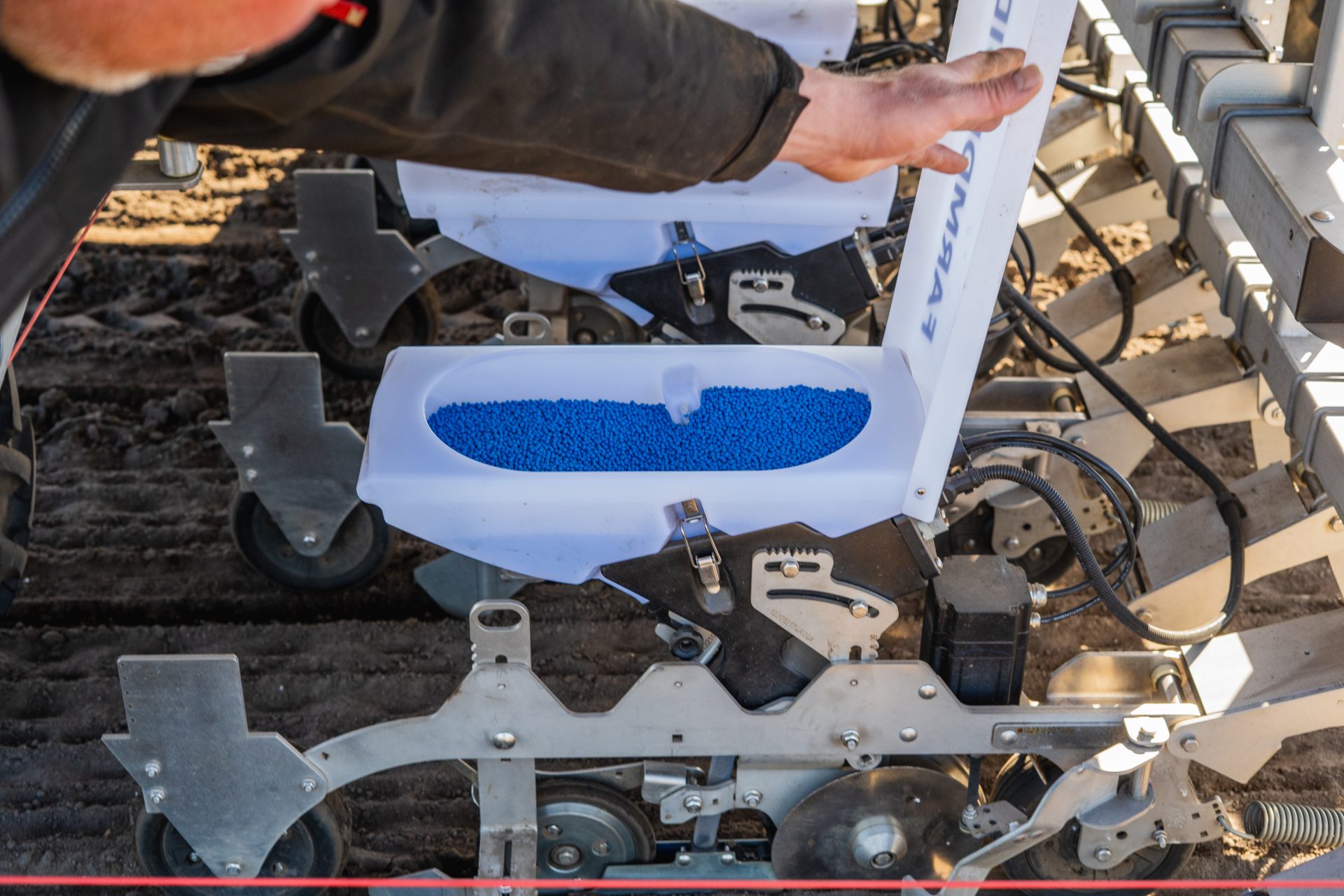
Another seeding season has been underway since March, and we are here to share mid-season updates with you. How many FarmDroid FD20 field robots have already been tirelessly working in the fields? How many hectares have they been seeding? Have any of these robots been spraying at the same time? Have they already started weeding? Let’s dive into the numbers behind the season so far.
Precision seeding vs. line seeding
Most FarmDroid owners make use of the robot’s ability to seed with high precision. In fact, around 90% of our robots operate this way, and that has also been the case this year.
Why? There are two main reasons.
First, placing seeds at uniform distances supports more even germination and plant growth, which can lead to better yields.
Second, precision seeding allows farmers to weed both inter-row and in-row. Without it, farmers cannot weed between the plants and are limited to inter-row weeding only.
Do you know how the FarmDroid FD20 uses RTK GPS technology to map the field down to each individual seed? Because the robot knows exactly where every seed is placed, it also knows where to weed and spray, even before the plants emerge. No need for camera detection.
When seeding some crops with FarmDroid, it’s not just a preference but a requirement to use precision seeding. Beets, for example, need enough space around each plant to develop properly, so they must be sown using precision seeding, with a minimum of 8–10 cm distance between each plant.
Mid-season numbers with FarmDroid FD20
Seeding
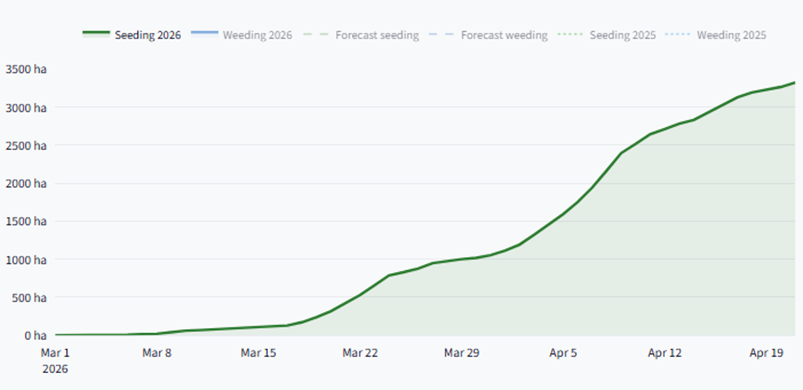
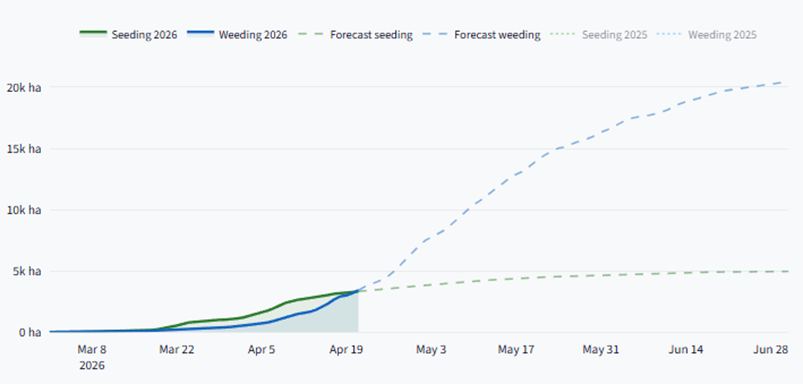
So far, 59% of all FarmDroid FD20s in the field have been active in seeding, covering 3,326 hectares to date, and many are still not finished. These fields have been seeded with sugar beet, onions, chicory, red beet, flowers, legumes, grains and oilseed, parsnip, peas, spinach, lettuce, and more…
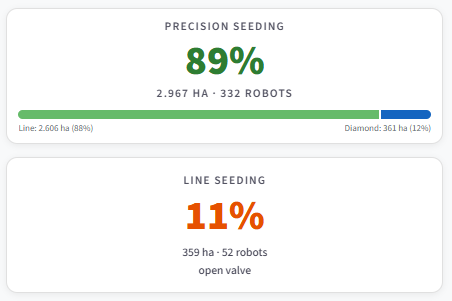
Of the fields seeded, 89% have been seeded using precision seeding, and out of these, 12% have been seeded using diamond-shaped seeding pattern. The diamond shape is seen mostly in sugar beet, onion, and chicory. The remaining 11% of the fields have not been seeded using precision seeding, but in straight lines with seeds placed closer together, usually with 3–8 cm distance. We see this type of line seeding used in onion, flowers, peas, and grass seed.
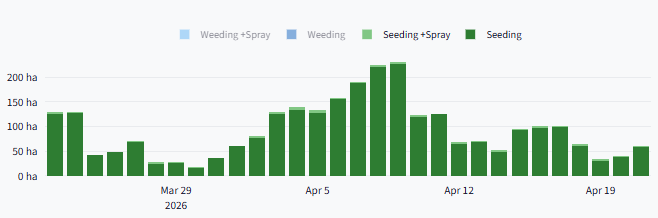
The most active robot so far this season has seeded 46.9 hectares of sugar beet and fennel, currently holding the record. The second most active robot has seeded 46.6 hectares of sugar beet, onion, and red beet and weeded 25.9 hectares already to this day.
Spraying while seeding
13% of robots currently seeding have also been micro-spraying simultaneously. 70% of them have been working in chicory and sugar beet fields in the Netherlands, and they have covered 78 hectares seeding and spraying so far.
Weeding
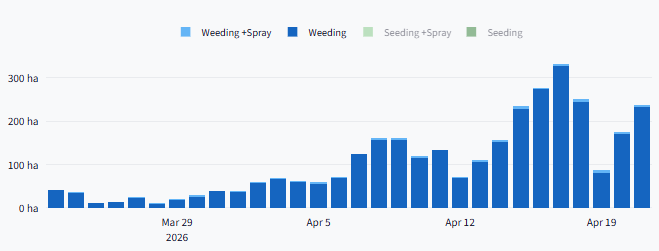
FarmDroid recommends that robot farmers start weeding right after they are done seeding the field, no later than 9 days after seeding. It makes us proud to see 83% of the robots seeded have already started weeding. So far, 3,418 hectares have been weeded, and the crops leading are sugar beet, onion, red beet, and other vegetables.
Observations from the field and the mindset of FarmDroid customers
Farmers know every season is different, and seeding is always a critical period where many factors need to align. Soil moisture and temperature have to be right, the seedbed must be prepared properly, weather conditions need to cooperate, and the robot must be set up and adjusted correctly for the crop and field conditions. With so many variables in play, challenges can occur, and that is part of farming.
What matters is how quickly and effectively those challenges are handled. That is where our development/support teams and partners have performed strongly. Despite some issues early in the season, they have responded fast and worked closely with customers and partners to solve problems well. In fact, support tickets are down 40% this season, making it one of our strongest seasons so far.
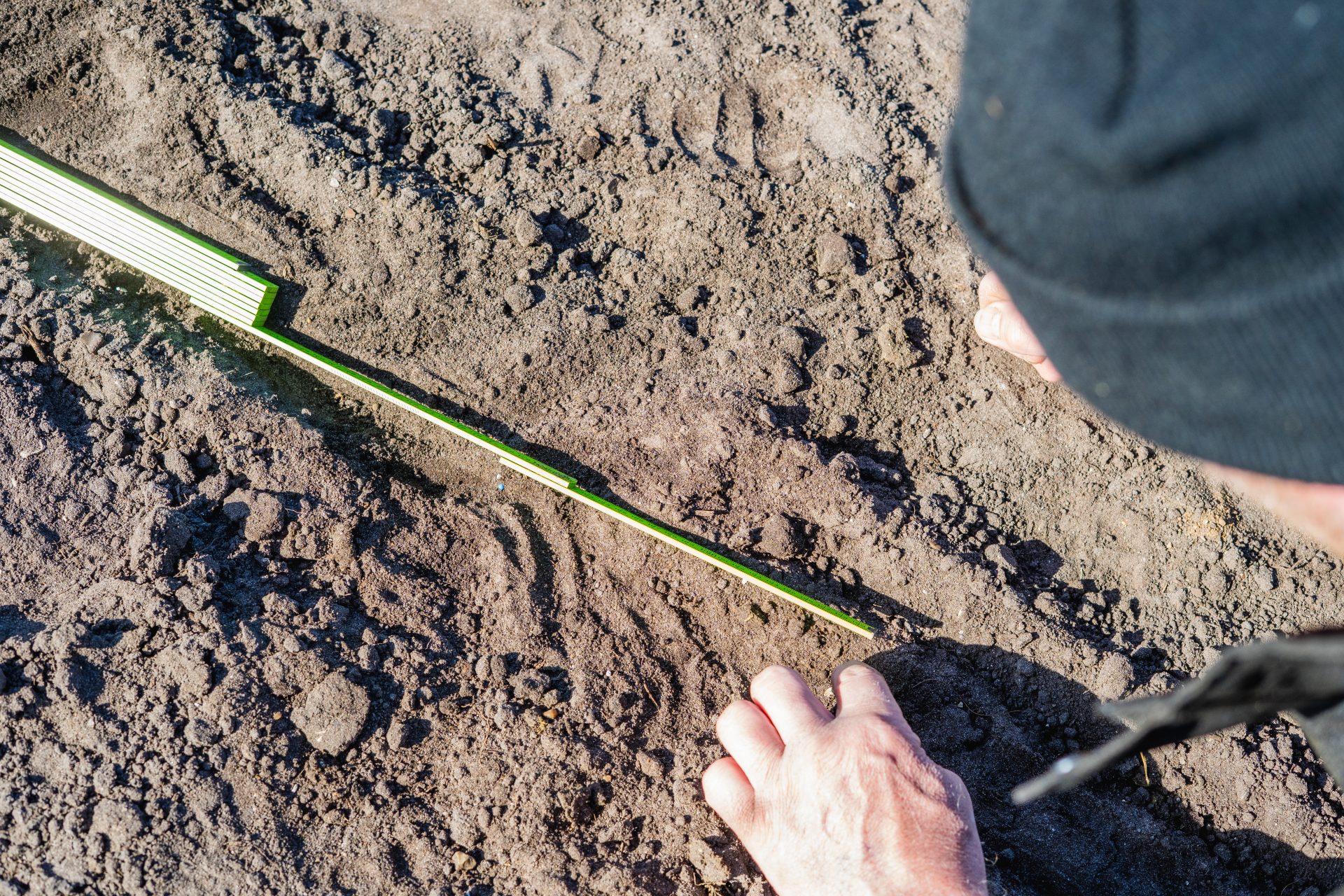
Our customers value the technology and want to succeed with their FarmDroid. They stay engaged, even through the challenges that sometimes come with adopting a new technology in the field. That commitment is reflected in how actively they use and share their FarmDroid experience, including submitting photos from their fields to our photo competition.
FarmDroid Support for smooth operations
With our customers’ best interests at heart, our support team works closely with FarmDroid owners to help them handle the challenges that arise during the season, whether small adjustments or bigger issues. We are always a call or message away, and helping customers maintain smooth operations remains a constant priority at FarmDroid. Together with our local partners, we work to make sure no one feels alone in the field.
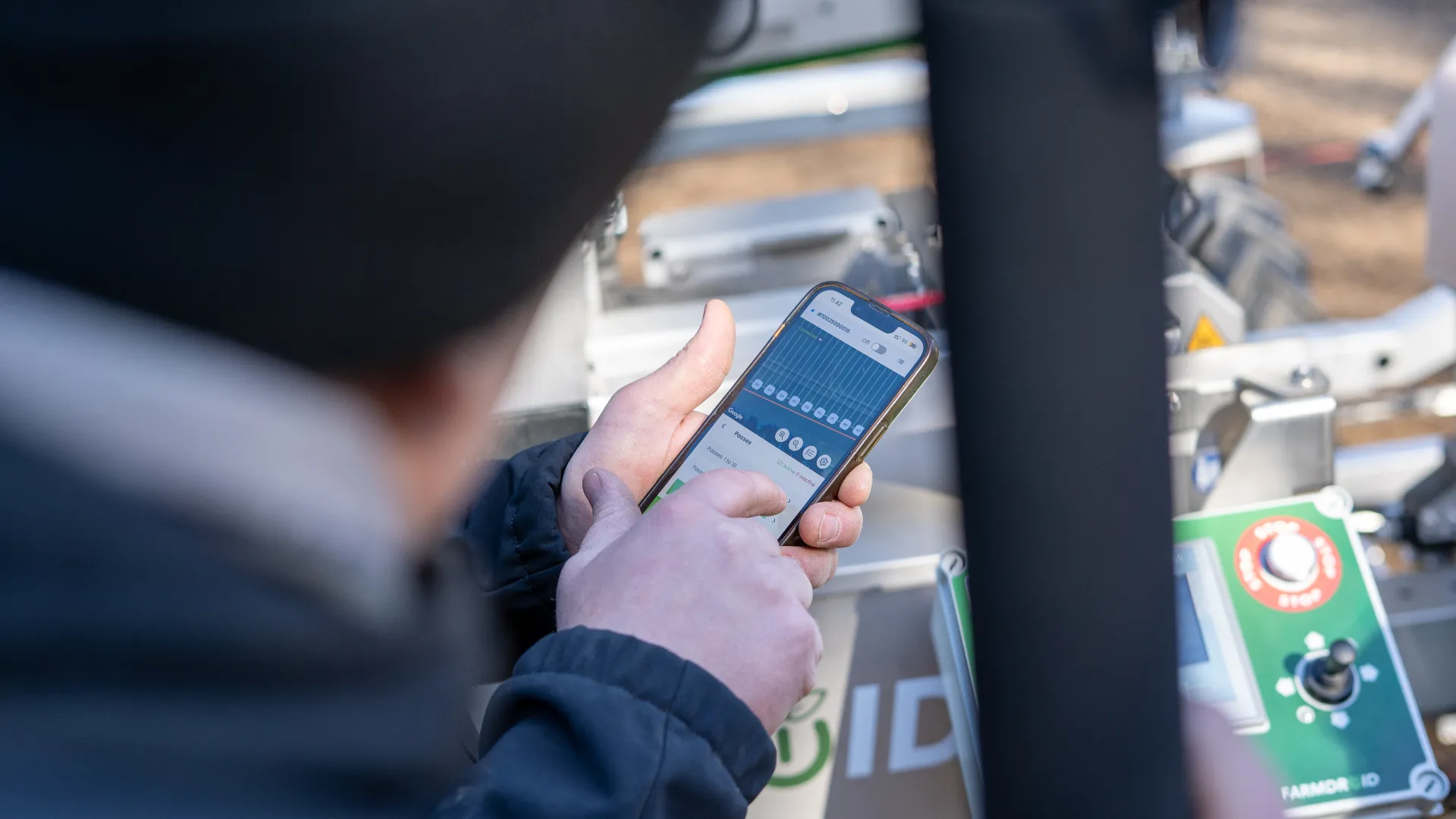
And support continues to grow. With the addition of our new team member, FarmDroid AI Assistant Odin, we are well equipped to help farmers keep their operations moving.
Looking ahead
Precision seeding is usually the first task of the season for most FarmDroid robots. Some robots may start the season with weeding, and others are already spraying while seeding, but generally, mechanical weeding and spraying will increasingly play a larger role from now on as the season progresses.
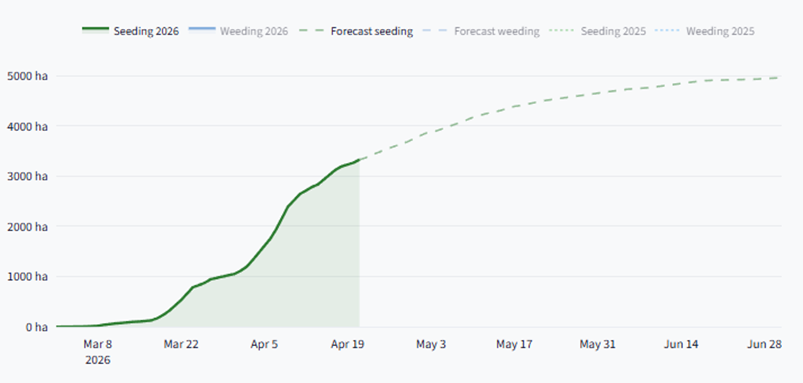
The season is still unfolding. We expect most remaining robots to complete seeding by the end of June. At the same time, more and more FD20s will be carrying out mechanical weeding and micro-spraying in parallel. Most fields are expected to be weeded once a week and micro-sprayed when needed based on crop type.
We will share another season update soon. Stay tuned.